
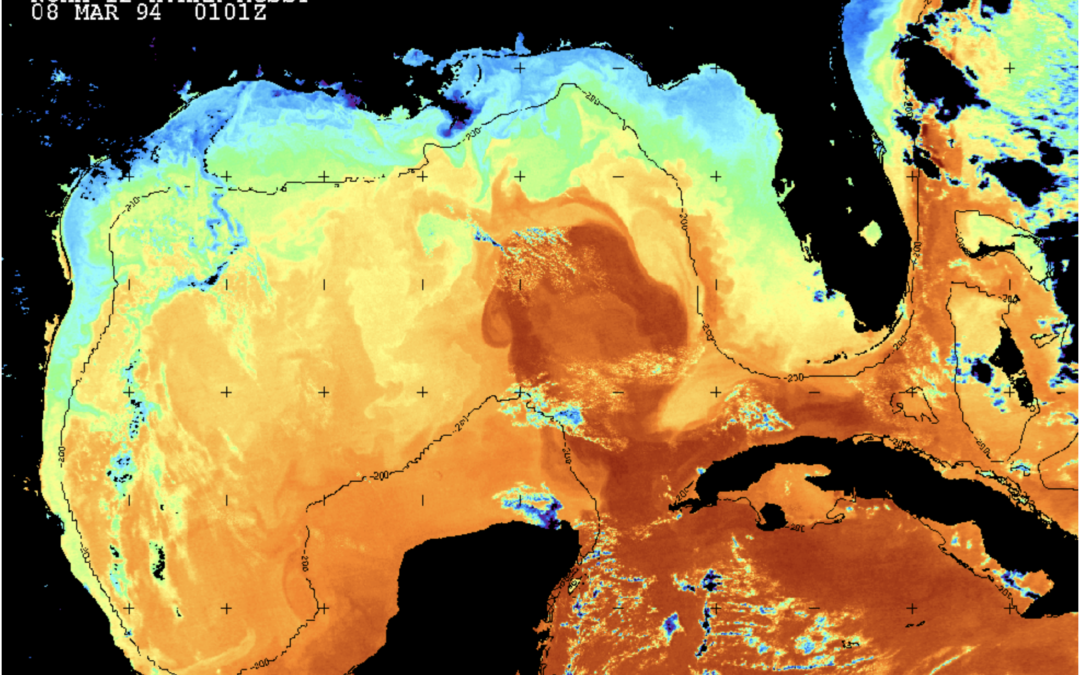
For most of my career as a climate scientist, hurricane and severe weather forecasting focused primarily on the atmosphere. We tracked pressure, winds, moisture and sea surface temperatures because those were the best tools available. Today, one of the biggest advances in hurricane science is recognizing that what lies beneath the surface of the Gulf of Mexico can be just as important as what happens in the sky.
That brings us to one of the most fascinating ocean currents on Earth—the Loop Current. It is a giant river of warm tropical water that enters the Gulf of Mexico through the Yucatán Channel, loops northward into the Gulf, and exits through the Florida Straits to become the Gulf Stream. It has existed for thousands of years, but the Gulf around it is changing, warming at about double the rate of oceans around our planet. Because of this change, evidence increasingly shows that the Loop Current has become a warmer conveyor belt—not necessarily a faster one.
Understanding that distinction may be one of the most important keys to understanding the future of hurricanes along Florida’s Gulf Coast.
Over the past fifty years, the Gulf of Mexico has warmed substantially. More importantly, the warm layer now extends much deeper below the surface. This is far more important to hurricanes than sea surface temperature alone. In places, exceptionally warm water, sometimes exceeding 86°F (30°C), now extends hundreds of feet below the surface, creating an enormous reservoir of stored energy. Think of it as the difference between a shallow puddle warmed by the sun and a deep lake that stores heat for months. Both may have the same surface temperature, but the deep lake contains far more energy. That deep reservoir is what hurricanes tap into, making rapid intensification much more likely.
The Gulf’s geography is central to this story. Surrounded by land and connected to the Caribbean and Atlantic by only two narrow passages, it behaves almost like a giant bathtub connected by two pipes. That confinement forces the Loop Current into its characteristic northward bend and causes it to periodically pinch off enormous warm-core eddies, some more than 200 miles across. These rotating pools of warm water slowly drift westward across the Gulf, transporting tremendous amounts of heat. When hurricanes cross ordinary warm water, their powerful winds stir colder water upward, reducing their fuel supply. But when they pass over the Loop Current or one of these warm-core eddies, there may be little cool water available to reach the surface. Instead, the storm continues drawing energy from warm water extending hundreds of feet below. If atmospheric conditions are also favorable, explosive strengthening can occur. Freshwater also plays a role in this. Major river systems, along with increasingly intense rainfall and hurricanes themselves, deliver enormous amounts of freshwater into the Gulf. Because freshwater is lighter than saltwater, it forms a less dense surface layer that suppresses vertical mixing. This separation, called stratification, helps retain heat near the surface while preserving the deeper warm reservoir below.
Since 2017, the Gulf of Mexico region has been affected by an extraordinary number of Category 4 and 5 hurricanes. Rita, Ida, Ian, Helene and Milton, among others, demonstrated the critical role deep ocean heat can play in hurricane intensity.
The Loop Current has always been a dynamic, natural system. Its northward reach changes. The timing of eddy shedding varies. El Niño, the Atlantic Ocean and other natural climate cycles all influence its behavior. Climate change is acting on top of this natural variability, not replacing it.
The encouraging news is that our ability to monitor the Loop Current has never been better. Satellites, underwater gliders, Argo profiling floats, sea-surface height measurements, salinity observations and increasingly sophisticated artificial intelligence are giving scientists an unprecedented view of what is happening beneath the surface. These advances are improving hurricane forecasts and moving us toward digital twins of the Gulf that will simulate future conditions with remarkable accuracy. At the Climate Adaptation Center, we believe these tools should become part of routine decision-making for communities, businesses and emergency managers throughout Florida.
The atmosphere still determines where a hurricane goes. Increasingly, however, the Gulf helps determine what that hurricane can become.
The Loop Current has flowed through the Gulf for thousands of years, quietly transporting tropical heat toward Florida. Today, the Gulf around it is warmer, the heat reservoir is deeper, and the consequences are becoming increasingly evident. Understanding this hidden engine is no longer simply an oceanographic curiosity. It is essential to improving hurricane forecasts, strengthening coastal resilience and protecting the people, communities and economy of Florida’s Gulf Coast.
——————–
Bob Bunting is the founder and CEO of the Climate Adaptation Center, where he leads efforts to help communities become more resilient to the impacts from a warming planet. He is a former NOAA scientist and executive with the University Corporation for Atmospheric Research (UCAR), an entrepreneur, and educator who has taught at six universities with decades of experience in weather, climate, and technology innovation. This column is part of EcoBeat, a monthly series produced by the Science and Environment Council to bring leading Gulf Coast environmental voices directly to the public. Learn more at scienceandenvironment.org/ecobeat.
COVER PHOTO INFORMATION
Photo Credit: LSU Earth Scan Lab Coastal Studies Institute and NOAA
Caption: The Loop Current in the Gulf
 Susan Glickman
 Bill Johnson
 Lee Hayes Byron
 Duanne Andrade
 Amber Whittle
 Sarah Dearman
 Donn Githens
 Mike Kelcourse
 Emily Grant
 Zack Rasmussen
 Abbey Tyrna, PhD
 Sandy Gilbert
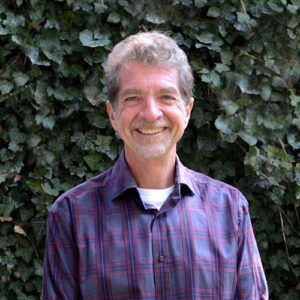 Bob Bunting
 Erica Gies
 Maya Burke
 Amanda Boone, PE
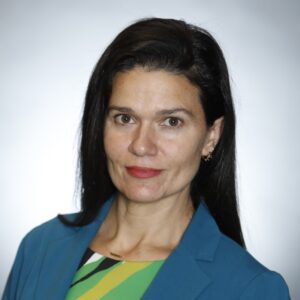 Jaclyn Lopez, JD
 Joe Bonasia
 Rabbi Ed Rosenthal
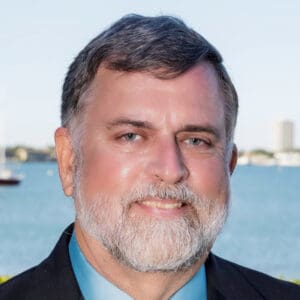 John McCarthy
 Ronda Ryan
 Howard Hochhalter
 Kylie Wilson
 Nate Brennan, PhD
 Damon Moore
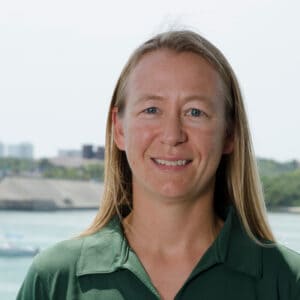 Katie McHugh, PhD
 Craig Pittman
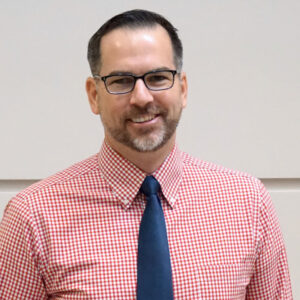 Ed Sherwood
 Dave Tomasko, PhD
 Jennifer Hecker
 Randy Wells, PhD
 Carl Hiaasen
 Jono Miller
 Emily Hall, PhD
 Mark Hostetler, PhD
 John Keifer, PhD
 Jeanne Dubi
 Aedan Stockdale
 Hillary Van Dyke
 Uzi Baram, PhD
 Tony Clements
 Aliki Moncrief, JD
 Christine Johnson, MBA
 Charlie Hunsicker
 Jim Strickland
 Jennifer Rominiecki
 Bill Waddill
 Timothee Sallin
 Paul Owens
 Van Linkous, PhD
 Steve Cover
 Juliette Desfeux
 Jon Thaxton
 Damon Gameau
Recent Comments